
The sun battered our backs as the clouds slowly drifted by below us like a traffic jam in New York City. But, we were far from any major city you could think of, away from civilization and cell reception. Maybe this was the goal of Pachacuti Inca Yupanqui, whom was the ninth ruler of the Inca from Cusco and supposedly commissioned the site around 1450. The land lay dormant from when the Spanish invaded the Inca in 1528 until Hiram Bingham rediscovered it in 1911.
By the time famed archaeologist Hiram Bingham rediscovered Machu Picchu, it was overgrown with weeds and trees and barely recognizable compared to what it is today.

It took a full year to burn all the trees and limbs and weeds away to reveal the majesty that is Machu Picchu. There are so many hidden gems in this structure, that there are whole books that try to cover it all, but cannot, I’ve read a few. Some of them are Turn Right at Machu Picchu, Machu Picchu: Exploring an Ancient Sacred Center, and Lost City of the Incas by Hiram Bingham. All are excellent reads. The second one, exploring the sacred center, is pretty costly but the best place to find cheaper is used on Ebay.
The Inca worshipped the land. They worshipped the mountains the most, then the rivers and streams and the soil itself. They believed the mountains created good crop seasons with just the right amount of rain and sunshine, life’s perfect balance.

It was supposed to be rainy season, but the sun had other ideas. We had layered up not knowing what to expect on temperatures or precipitation. We were told by our guide that “rainy season” doesn’t really exist anymore due to climate change. It’s an excuse they use to shut down the Inca Trail for a month in February to repair and fix the bathrooms. So, there you got on that little tid-bit. We had never planned on doing the Inca Trail regardless.
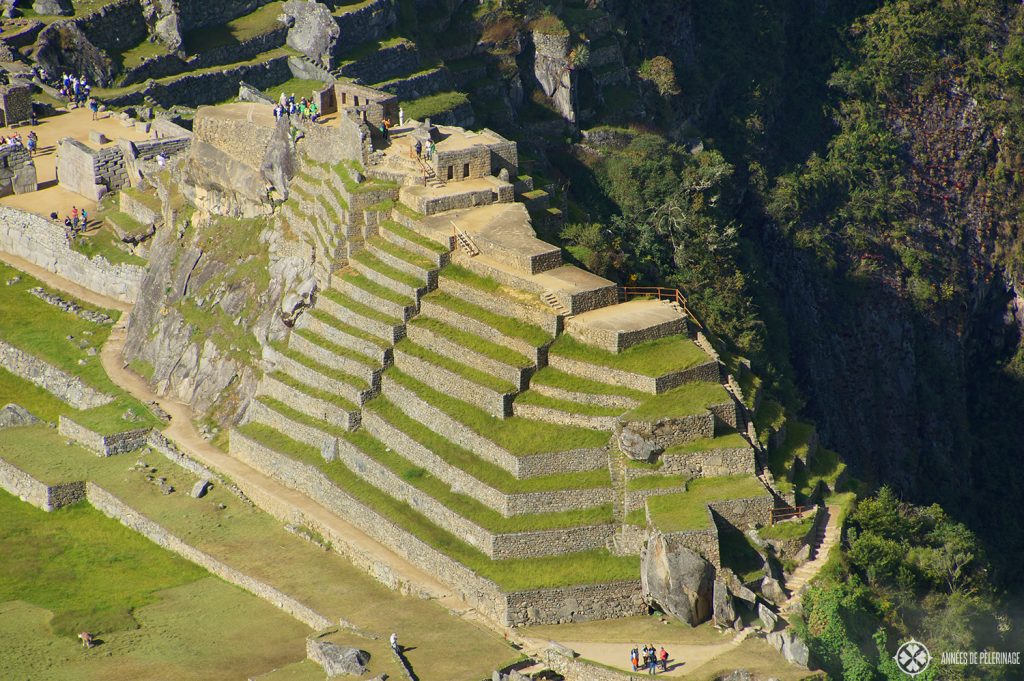
The first site our guide took us to was the House of the Guardians. These courageous souls protected the entrants to the city and were housed in a stone hut on the hilltop overlooking the city, shown below, that is just above where we took the latest picture above.

I specifically brought my Chiefs Kingdom red flag with me to take a picture overlooking Machu Picchu to post. As I removed the flag from my backpack, another tour guide immediately noticed it was a flag, other than a country’s flag, and started yelling in Spanish. This alerted my guide that spoke English and he rushed over to me to inform me that no flag pictures are allowed other than your country’s flag. This is due to the respect of the land and the culture. Bummer, but I get it. I would later use the flag in converting an Eagles fan that was a local walking by as we ate crepes at a place across the street from our Airbnb.

We climbed back down towards the entrance gate to the city. This was the last photo in my last blog post show the large rectangular-door like structure. There was an actual door back in 1450, but today, it’s wide open with nothing.
Underneath the entire site of Machu Picchu is an ancient aqueduct that reaches into a nearby mountain spring and runs water throughout the entire city. It’s a feat that guides are quick to point out and is extremely impressive. I witnessed water still running in the various pools through the site. It’s extremely dirty naturally, but the dang thing still works! Unreal the Inca made something so perfect, it stands the test of time 100s of years.
The stones were plentiful with walls and small encased closet and storage spaces everywhere. In most rooms there were small squares cut out in the stone that allowed vantage points of the view that would comprise a Modern Wonder of the World.
We weaved in and out of the stone walls that seemed like an endless path. Around the corner, we were guided to a wall overlooking another hut below, but this one had no ceiling and we were not allowed to go down and enter, it was too sacred. This was the Temple of the Sun. In my last blog post, I discussed the sun’s rays beaming from the Sun Gate down through the windows of this structure to the the middle of the temple at the summer and winter solstice. Coming from either direction. The temple is below.

In this photo, you can see the window coming from the eastern direction. There was a door that filled that curve you see that is open to the temple. That door had a hinge and only the high priests were allowed inside the temple to present gifts to the gods, their most sacred treasures. The door has since been removed. The window that brought the sun’s rays from the Sun Gate is to the right wall of the temple of this picture, as the Sun Gate is a couple miles away to the right on a mountaintop. A feat of architecture that still astounds, especially without the technology and tools we have today.
We admired the fine craftsmanship of all the stones in which you couldn’t fit a single piece of paper through the sides of the stones. It was remarkable. No words can justify what we witnessed.
Next on the tour was the Intihuatana stone located in the Sacred Plaza. This stone is set at the highest point of Machu Picchu, and for good reason. Without knowing anything on the placement or degree of curvature, you would pass by this stone without second thought. It was strategically placed in between the four mountains that were placed in each direction around Machu Picchu. The name “Intihuatana” actually means “To tie up the sun” from the Quechua language, the language of the Incas. The Inca believed that the day the sun never rose, was the day all life would cease to exist, so they devised a way for the sun’s shadow to form harnesses on the ground, therefore “tying” the sun to the ground so that it would always stay in the sky.
The stone is set high upon the Sacred Plaza, above a tiered, pyramid setup. Through its high elevation, it is thought to connect the different levels of the Inca mythology (Hana pacha, Kay pacha, Ukhu pacha; Spiritual World, Now, Underworld) in one focal point.
Its primary function was most certainly astronomical. It looks a bit like a sundial, and that is actually not far away from the truth. During the two equinoxes (so March 21st and September 21st) the sun stands directly above the Intihuatana – creating no shadow whatsoever. This is only possible because the upper part of the Intihuatana stone has an inclination of around 13 degrees. The fact alone is marvelous since similar stones in the area of Quito didn’t require this angle and hint at the grand depth of the astronomical knowledge of the Inca.
Here is a picture of the famous stone up close:

I had read that not long ago, someone was filming a movie on the site and one of the crane’s holding a camera fell on the stone and cracked a piece off. Large cameras are now prohibited in Machu Picchu. I can’t imagine someone or a company being so careless on priceless history. The Intihuatana is often wrongly associated with the solstices – but that is a myth. Only the Temple of the Sun (a few hundred meters away and in pictures above) casts an auspicious shadow on that date. The Winter Solstice festival is known as Inti Raymi and is still being celebrated in Cusco each year.
William Prescott possible wrote something about the Intihuatana way before, in 1847 to be precise: “The period of the equinoxes they determined by the help of a solitary pillar, or gnomon, placed in the center of a circle, which was described in the area of the great temple and traversed by a diameter that was drawn from east to west. When the shadows were scarcely visible under the noontide rays of the sun, they said that ‘the god sat with all his light upon the column.” This was shocking to me, because I originally felt they did this for the shadows, but the real meaning came from the sun being placed directly overhead so that all the beams were being cast upon the stone itself, hence no shadows at all. Amazing. These stones are placed in other Incan sites around Peru, this is not the only one.
The next destination was a rock cut-out of the landscape behind it. You were not allowed to touch this magical rock anymore, but a few of us, including me, did anyway. It is said there is magical powers of the rock for all whom touch it.

The jagged edges at the top represent the mountains directly behind the stone on an adjacent mountain range. The craftsmanship is unlike anything I’ve ever seen. You can see a glimpse of the adjacent mountain in the top left portion of the picture in the background. You can see the peaks match with the stone carving.
The hike around the sacred grounds were tiring, especially when you are at 7,700 feet and 3-4 layers on and 80 degrees. We were given some time to sit and relax on some rocks and down some water to recharge for the walk back. We were on the far end of the site, farthest away from the entrance. There were quite a few others taking a break as well from their own tours.
Once we got going again, it was more a straight shot back. We stopped mingling with alpaca’s. There were right next to us on the way back and other tourists were feeding and petting them.


This about formally ended our hike of Machu Picchu. We had seen the major areas of attraction and our guide was fantastic. There was only five of us total on the tour, not including our guide and our party of three was a majority of it.
The bus was easy to catch back down the mountain to Aquas Calientes. Before our tour was over, our guide pointed us to Mapacho Craft Beer Restaurant overlooking a raging river and said it was the best in town. The food and view was spectacular. The one mistake I made was ordering a frozen alcoholic beverage, forgetting to never drink water or ice in Peru. I would have stomach problems all night long later that night. So, lesson learned, ugh.
Here is the view of our balcony view of the raging river, and man was it raging. You can also see the aforementioned culprit to my stomach issues.


Our dishes were delicious, much more delicious than I was expecting for a restaurant on a main strip in the middle of nowhere. I had the alpaca on the left with noodles.

We happened to run into a father and son we met in the airport in Lima heading to Cusco. His son had moved to Lima for work from NY and his father had come down to visit while he had some time off. Always great running into fellow Americans while traveling abroad and getting travel tips and updates on their journey.
We still had some time to kill, so we ventured around the local flea markets as there were tons. Chanel and Burt bought their kids some items, I bought another magnet for my fridge to add to all my destinations I’ve traveled to. My grandma always did this and I’ve always done it, and it’s something I try to do whenever I can. My fridge is now stocked with them.
There was live music back at the train station as we waited for our train. We sat front row and vegged out. We were hot and tired and we’d done a TON of walking all day, especially after getting up before the sun rose. It would be a sleepy train ride back to Ollantaytambo, then van ride back to Cusco. The same exact route back that we came. I didn’t want to miss another venture into the Amazon on the train, but I was zonked out in a matter of 20 minutes.
We disembarked the 360 Train on the Inca Rail and found our driver of the van taking us back to Cusco. This would be another 90 minutes in the van and we arrived back in Cusco after the sun set. We still needed dinner when we got back and our first choice was closed, so we ended up across the street from the original restaurant and they had some live music.
They were playing La Bamba in their native tongue…it was awesome. I just wished they had played longer. Clips are below:
After dinner, we walked around the main square in downtown Cusco. There were street vendors everywhere and we wished the huge church was still open, but it was closed. The square was lively. Chanel bought a great work of art she took home with her.
Clip of the main square below:
It was an epic first full day in Cusco, the Incan capital. We were excited for the second full day with an ATV tour of the Sacred Valley, ziplining over the Sacred Valley, more ancient ruins and the salt flats.
More adventure awaited us….join us in the next blog post……
 Moonlit Wings Reflect the Stars That Guide Me Towards Salvation